

By Clyde Hays, Vinland Meads and Hays Manor Farms
Landowners keep asking me whether I’d be interested in putting beehives on their properties. I’d like to say yes more often. We have room to grow. Finding enough people who want to do the work, and keep doing it, has been the harder part.
Here at Vinland Meads and Hays Manor Farms in Murchison, Texas, more hives could mean more honey for our meadery and a larger farm operation. But every colony brings responsibility. Somebody has to inspect it, recognize trouble and follow through. Adding boxes is easy compared with making sure the bees in them are properly cared for.
That is what gets me thinking about humanoid robots. Could a capable robot work alongside a beekeeper and help us care for more colonies without stretching that beekeeper too thin?
The food behind the honey
Pollination is where this becomes a question about the food on our tables. USDA reports that more than 100 crops grown in the United States rely on pollinators, including many fruits, nuts, berries, melons and squash. Honey bees help do that work alongside wild bees and other pollinators. When we care for a colony, its value reaches beyond the honey we can harvest. It is also part of the living system that helps produce a varied diet. [1]
For growers, dependable pollination can affect how much a crop produces and the quality of the harvest. The Food and Agriculture Organization describes how inadequate pollination can reduce produce quantity, fruit quality and seed set. That connects the work in an apiary to orchards, berry fields, vegetable farms and the people who depend on those harvests for food and income. If we want reliable agriculture, we have to take seriously the care of the pollinators doing part of that work. [5]
We would not lose every source of food if honey bees disappeared, and adding managed hives cannot replace protecting wild pollinators and their habitat. The stakes are still substantial: many foods that bring variety to our meals benefit from this living workforce. That is why I see helping beekeepers as a worthwhile use of robotics. If practical assistance lets us care for more healthy colonies, it could support the pollination services agriculture needs. That is a bigger reason to pursue this than producing more honey for our own business.
A repeatable job around living bees
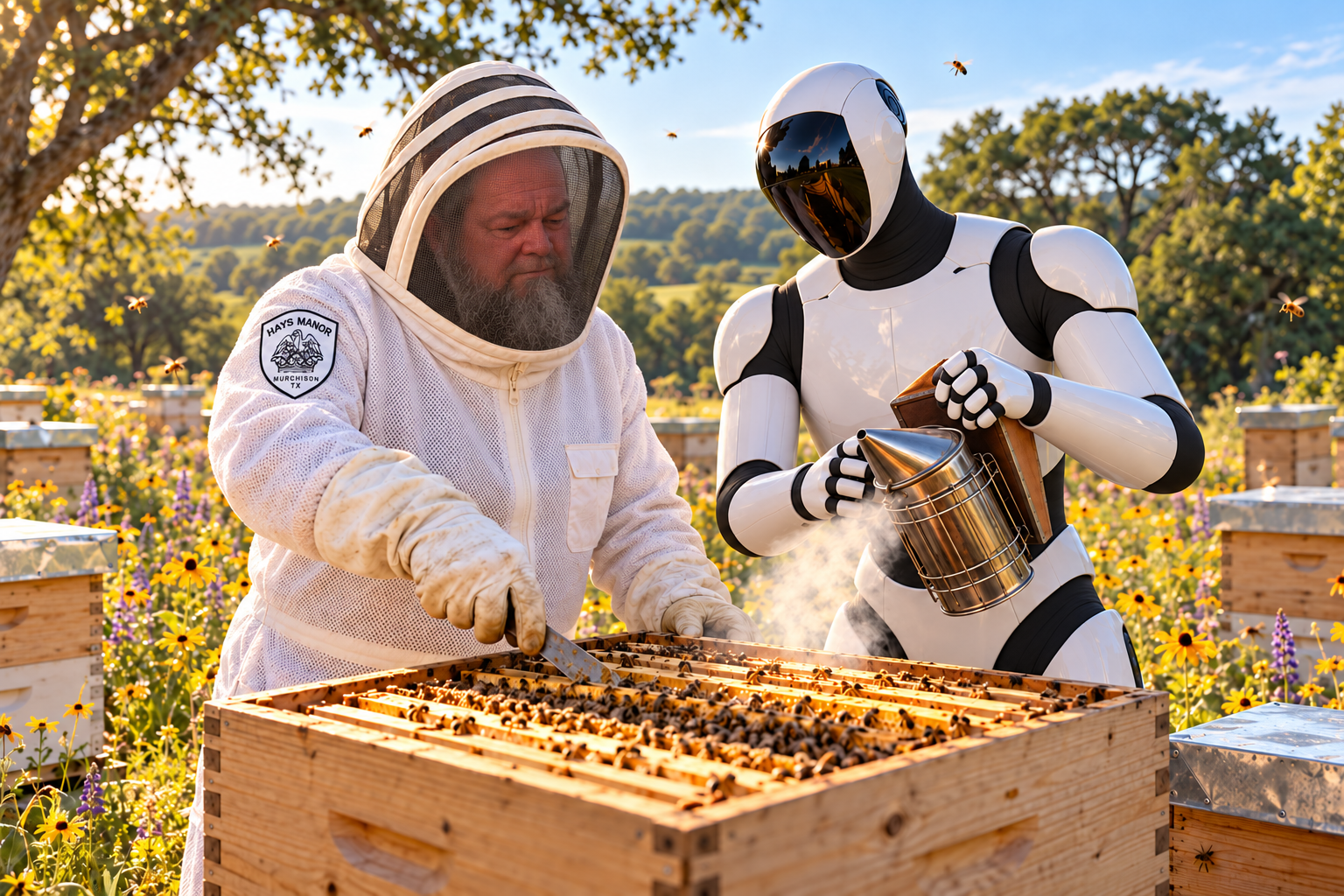
A beehive has something robotics developers can work with: consistency. Within a standard hive system, the boxes have known dimensions and hold a set number of frames in familiar positions. The contents change, but the equipment gives a robot a repeatable layout to learn.
Think about pulling a frame, holding it for inspection, turning it and putting it back. Then doing that again across the box, the hive and the apiary. Moving equipment and carrying supplies add more repetition and lifting. In the Texas heat, that work wears on a person.
I can imagine a robot eventually helping with those motions, including shaking bees off a frame when an experienced beekeeper decides that is appropriate. Those would be tasks to develop and test under supervision, with the beekeeper directing the work.
The consistency of a box does not make the bees predictable. Frames can stick, comb can be fragile, and a careless movement can injure bees or a queen. A useful machine would need gentle handling, reliable sensing and the ability to stop when something is wrong. I’m describing a future worth working toward, not saying today’s humanoid robots can safely run an apiary. These are the kinds of capabilities robotics researchers are actively working to refine today.
What we could learn from each frame
The part that interests me just as much is what could happen while a frame is out of the hive.
Imagine a camera scanning both sides and AI quickly mapping what is visible: areas of brood, honey, pollen, nectar and empty comb. With suitable training and validation, it might also flag possible queen cells or visible pests for a beekeeper to examine. Instead of simply saving a picture, the system could help us record what was on that frame and where.
Image analysis is already a real area of beekeeping research. The FAIRHiveFrames-1K project provides 1,265 annotated frame images and preliminary AI models for identifying categories such as capped honey, worker brood, pollen and empty comb. That is useful groundwork, not proof that an automated inspection can recognize everything a beekeeper needs to know. [2]
Bees covering the comb, poor lighting and an unclear view could all limit an image. Hidden disease or an uncertain queen situation would still need investigation. I would want the system to show where it was unsure and let the beekeeper correct its findings. A confident-looking answer is no help if it sends us in the wrong direction.
Now connect those observations to a server. Give each record a frame identity, its position in the hive, the colony, the apiary and the date. Keep the images alongside the map, the beekeeper’s notes and whatever work was done. If a frame moves to another colony, record that move too.
Over time, we could compare the same frame across inspections, follow a colony through a season and look for patterns across an apiary. Is the brood area expanding? Are food stores shrinking? Did a change show up after a split or a move? Paired with weather, forage conditions and hive measurements, those records could help us ask better questions and decide which colonies need a closer look. They would not, by themselves, prove what caused a change.
Beekeepers and researchers already collect this kind of longer-term evidence. One study combined sensor readings from 53 hives with expert measurements of colony traits. Another used hive scales and pollen sampling to study colonies in different agricultural landscapes. The opportunity I see is bringing that history together with frame-level observations and practical physical assistance during the work we already do. [3] [4]
More help without losing the beekeeper

The beekeeper’s judgment would remain central. A robot that takes on useful physical work and keeps better records could give that person more time to assess colonies, plan the next visit and teach someone else. That is the kind of help that could make expansion manageable for us. The goal would be healthier, well-managed colonies that can keep doing their part in pollination, with enough skilled human attention to support them.
There is another benefit worth considering. A beekeeper’s experience can keep growing while their ability to lift a full honey box declines. Some beekeepers move from deeper boxes to shallower ones to make the weight more manageable. Physical assistance could help experienced beekeepers remain active longer, keeping their knowledge in the apiary.
With dependable help, I would also like to grow more of our own berries and fruit for the meadery. The farm would still need people who understand agriculture and care about the results. More capacity could let us put that knowledge to work on more of the land available to us.
I would welcome a conversation with a robotics team willing to work alongside beekeepers on these questions. Start with a useful task, prove it can be done safely around live bees, and build from there.
We already have landowners asking for bees. I’d like to have the help to say yes.
