
Mead may be the world’s oldest alcoholic drink, but no two meaderies make it quite the same way. Over the centuries, methods have evolved—from ancient clay amphoras to stainless steel tanks, from spontaneous fermentation to precision-controlled yeast cultures. Today, there’s a wide range of approaches, each with its own philosophy and flavor profile.
At Vinland Meads, we honor the deep roots of mead making by using an old-world, layered process that prioritizes patience, purity, and the natural character of the ingredients. It’s a style passed down through my family, and it gives our meads a richness and complexity you can taste in every sip.
Mead in History: From Sacred Drink to Royal Table
Mead’s story stretches back thousands of years—long before wine or beer. Archaeologists have found traces of honey-based alcohol in Chinese pottery from as early as 7,000 BC. In Norse sagas, mead was the drink of warriors and poets, said to bestow wisdom and inspiration. In Celtic lands, it was shared at weddings and royal gatherings, believed to bring prosperity and fertility—this tradition even gave rise to the term “honeymoon.”
Ancient mead making was often a matter of chance. Honeycombs left in the rain could ferment naturally, producing a sweet, mildly alcoholic drink. Over time, cultures learned to control the process—fermenting honey with water in clay jars or wooden casks, sometimes adding herbs, spices, or fruit for flavor and preservation.
While tools and techniques have changed, the essence of mead remains the same: honey, water, yeast, and time.
Monks, Mead, and the Birth of Beekeeping
In medieval Europe, monasteries were among the places where beekeeping joined practical work with spiritual meaning. Honey brought sweetness to the table, while beeswax supplied candles for worship. Religious writers also found lessons in the life of the hive, drawing on its cooperative labor and ordered community to reflect on devotion, discipline and care. They were contributing to a beekeeping tradition whose roots reached back into antiquity.
Within the monastery’s daily rhythm, the apiary connected the garden, the household and the church. Its products could feed a community and illuminate its worship, while the bees themselves invited contemplation. The medieval Franciscan writer Bartholomew the Englishman gathered earlier learning about bees and their products, including honey, mead and wax. His work shows how closely the practical study of nature could sit beside religious teaching.
Mead, too, belonged to this wider world of honey, hospitality and the table. William of Malmesbury’s account of St. Wulfstan describes an English custom of drinking mead or ale after meals, although Wulfstan himself preferred water. Wine also had an established place in monastic life: the Rule of St. Benedict addresses its daily allowance and urges moderation. Together, these sources reveal a richer tradition of food and drink than a single beverage or a single story of invention can capture.
At Vinland Meads, we draw inspiration from that meeting of patient work and respect for the natural world. For us, tending bees is about more than production; it calls for attention, care and reverence for the life of the hive. Making mead is more than chemistry, too. It connects the honey we work with today to a much older human tradition—one we carry forward in our own way, one batch at a time.
A Different Starting Point: The Honey
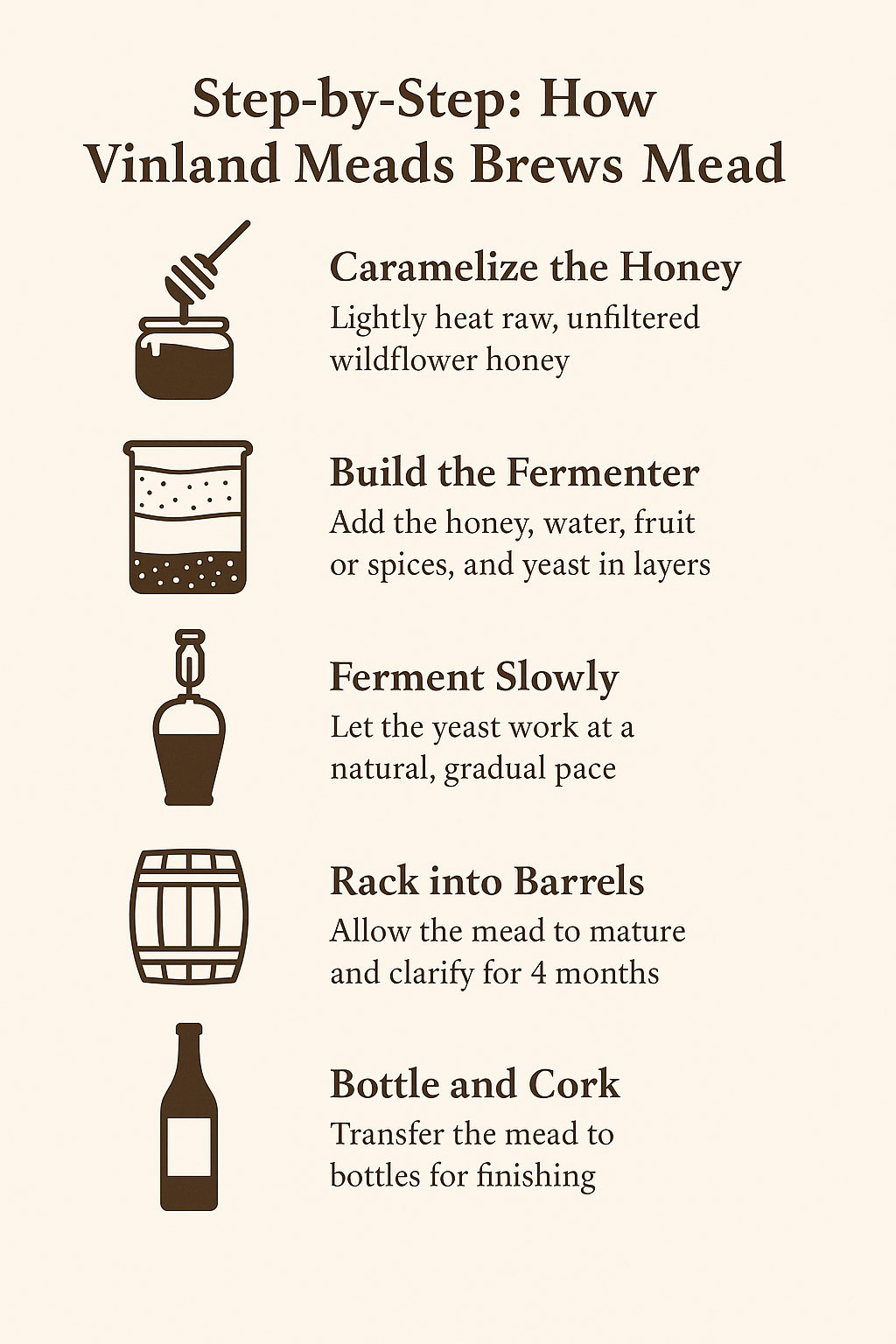
While many meaderies buy honey in bulk at the lowest price, we begin with raw, unfiltered wildflower honey from Texas hives and fields we’ve walked ourselves. We never pasteurize or dilute it, because we believe the natural aromatics and enzymes are part of the soul of the mead.
Before fermentation, we gently caramelize the honey. This step, known as the bochet process, creates complex sugars that yeast can’t fully convert to alcohol—leaving behind subtle layers of flavor that linger on the palate. —what my grandfather called “burning the honey”.
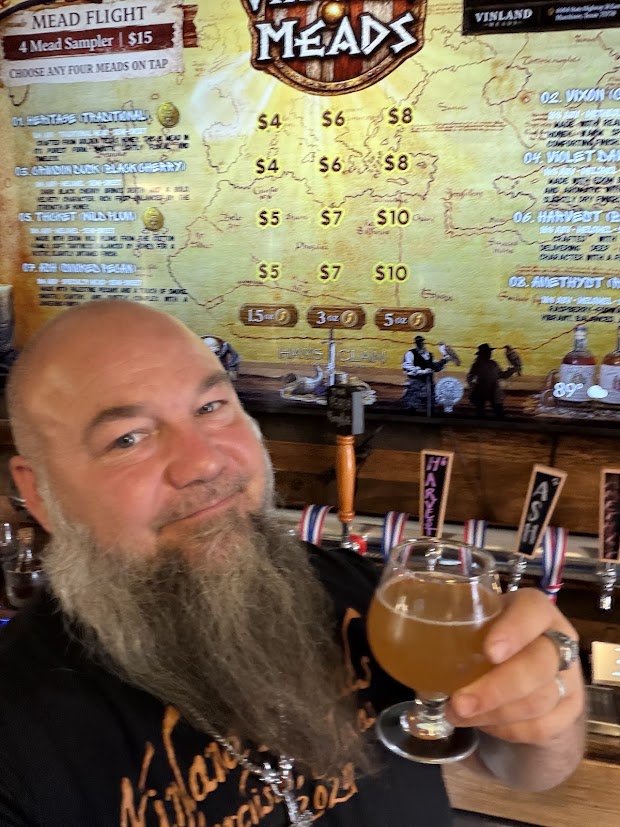
Layered Fermentation: One Step at a Time
Instead of mixing all the ingredients at once, we build our fermenters in layers:
Honey at the bottom.
A small amount of water.
Fresh fruit or spices—straight from the field and given a slight freeze to release sweetness.
The remaining water.
Yeast.
This means the yeast works through the honey gradually, one layer at a time. The slower pace means we don’t need chemical stabilizers, and the yeast never becomes stressed—a common cause of harsh or off flavors in mead.
The Long Wait
Once fermentation begins, we rack the mead into barrels and let it rest. Every two weeks, we move it off the sediment and allow it to clarify naturally. We repeat this over four months, giving the flavors time to develop and smooth out before bottling and corking.
This slower timeline may not suit every meadery, but for us, it’s essential. It’s what creates the bold, 16% ABV character of Vinland Meads—rich, layered, and made to be savored like a fine brandy.
Tradition Meets Today
We know every mead maker has their own way of working, shaped by their equipment, goals, and creative vision. Our way is simply one that’s steeped in history, family practice, and the belief that good things take time.
By relying on natural processes and minimal intervention, we keep the essence of our honey and fruit intact. Every glass of Vinland Meads is a taste of our history—untainted, unhurried, and unforgettable.
Historical references for this section:
Elizabeth Keen, The Journey of a Book (ANU E Press, 2007), chapter 3, “The properties of bees”: https://press-files.anu.edu.au/downloads/press/p28261/mobile/ch03s03.html
William of Malmesbury’s Life of St. Wulstan, J. H. F. Peile, ed. (Blackwell, 1934), pp. 70–71; page citation supplied by Worcester Cathedral Library: https://worcestercathedrallibrary.wordpress.com/2024/08/15/medieval-feasts-and-entertaining/
The Rule of St. Benedict, chapter 40: https://pressbooks.palni.org/ruleofbenedict/chapter/rb-40/
Columella, On Agriculture, Book IX, for the much older history of managed beekeeping: https://penelope.uchicago.edu/Thayer/E/Roman/Texts/Columella/home.html
